
 Svenska

Vi arbetar med olika typer av celler, batterier och energilagringssystemlösningar,
För frågor om våra produkter, vänligen kontakta oss så återkommer vi inom 24 timmar.



Vi arbetar med olika typer av celler, batterier och energilagringssystemlösningar,
För frågor om våra produkter, vänligen kontakta oss så återkommer vi inom 24 timmar.
In Almaty, Tashkent, Bishkek or Dushanbe, the question is not whether the power will go out this winter — it is when, and for how long. Shop owners here almost never ask how many kilowatt-hours a battery holds. They ask something much simpler: if the power goes at ten in the morning, can I still open tomorrow?
One Day Off Grid, Four Kinds of Loss
When the power drops, four things start costing money at the same time. Only one of them shows up in the day's takings.
|
Loss |
What it looks like |
Rough cost |
Recoverable? |
|
Stock |
Fridges warm up within two hours. In a Central Asian shop that means meat, sausage, dairy and ice cream first. A full chest freezer holds 24–48 hours — less every time the lid opens, and much faster in a July heat of 40°C. |
US$100–300 |
No |
|
Sales |
A closed shop earns nothing, and the loss lands hardest in the evening peak, when half the day's takings usually come in. In winter, scheduled cuts often fall exactly on those hours. |
US$150–500 |
Partly |
|
Staff |
People still clock in, stand around, and get paid. Some are sent home and paid anyway, some have to be rescheduled. |
US$15–50 |
No |
|
Customers |
Regulars walk to the shop next door, and the shop next door may have a battery. This is the part nobody puts in a spreadsheet. |
Hard to count |
Rarely |
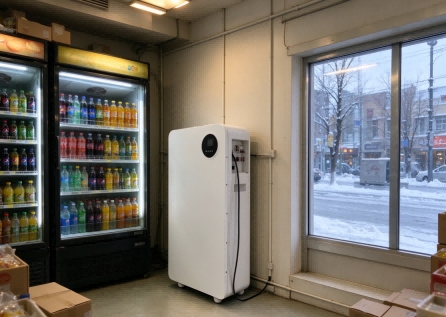
Five Shops, Five Very Different Days
Do not size a shop battery from floor area or from the electricity bill. Size it from two things: how many kWh the shop burns in a day, and whether the shop can afford to stay dark.
|
Shop type |
Daily use |
Loss per day |
What a battery covers |
|
Convenience store or mini-market |
8–12 kWh |
US$150–400 |
Fridges, lights, till and cameras for a full day |
|
Bakery, cafe or chaikhana |
10–15 kWh, fridges and lights only |
US$100–300 |
Half a trading day — keep the fridges and the till, skip the ovens |
|
Pharmacy |
4–7 kWh |
US$150–400 |
A full day — and for insulin and cold-chain stock, it is the only real option |
|
Hair salon or beauty studio |
3–5 kWh |
US$50–150 |
A full day plus the evening, with room to spare |
|
Small restaurant or canteen |
15–25 kWh |
US$250–600 |
Lights, fridges and till only; the kitchen is not coming back |
A convenience store is the hardest case, because winter cuts usually happen in the evening and at night, when nobody is watching the fridges — and meat is the most expensive thing in the shop. A pharmacy is the clearest case: insulin and other cold-chain medicines cannot wait out an outage, and one ruined batch can cost more than the battery itself.
A restaurant deserves a straight answer: a battery keeps the lights on and the stock cold, not the kitchen running. Electric stoves, fryers and samovar-type heaters draw 6–8 kW each. Say that honestly before the sale, not after.
What One Battery Can Actually Carry
A battery backup for small business is sized in usable kWh, not nameplate kWh. Our 10.24 kWh all-in-one unit gives 9.22 kWh of usable energy, which covers a convenience store's fridges, lights, till, router and cameras for roughly one full day — exactly the window between an evening cut and the morning delivery.
If the shop only needs the fridges and the till, a 5.12 kWh module is enough. It gives 4.61 kWh usable and stacks up to six modules (30.72 kWh) later, so a shop can start small and add a module each time it adds a fridge.
The local grid has its own rules
Much of what Central Asia calls an outage is actually a brownout: the lights stay half-on, the voltage sags to 180–200 V, and fridge compressors overheat and stall. This is where a wide input matters. Our all-in-one unit accepts 90–280 VAC and keeps giving the fridges a clean 230 V — on most days of the year, that protection alone is worth more than the backup hours.
And in winter there is one more rule: the battery must live in a heated room. Cells charge only between 0–45 °C, so an unheated warehouse in Almaty or Naryn in January is not an installation site — the heated back room is.
What to Switch Off Before the Lights Come Back
Most small-shop battery problems are not capacity problems — they are start-up problems. Everything tries to restart at the same instant, the surge trips the output, and the whole shop goes dark again.
Keep running: display fridges, chest freezers, LED lighting, till and card terminal, router and cameras.
Switch off at once: electric heaters, water boilers, ovens, fryers, air conditioning in summer.
Bring them back one at a time, thirty seconds apart, biggest first. This single habit prevents most "the battery cannot handle my shop" complaints. It matters twice over here, because when the grid returns it often returns with unstable voltage — let the battery take the first minute.
Where It Goes, and Who Has to Agree
Shop installations fail on logistics far more often than on technology. Four things decide whether the box ever gets mounted:
A warm, dry wall in the back room. Not in an unheated storeroom, not beside the tandyr or the boiler, not against a wall that takes moisture. Leave about 20 cm around the unit for airflow — and remember the 0–45 °C charging window in winter.
The landlord, in writing. Leased premises usually need written consent for wall-mounted electrical equipment. Get it before ordering, not after delivery.
The floor and the doorway. A module weighs 45 kg; the all-in-one unit 125 kg. Many small shops here trade from converted containers or ground-floor rooms of courtyard houses — check the route in and the load on the floor before you promise a date.
The noise. There is a fan, and a back room is fine but a counter is not. Do not put it where staff stand all day.
A Rough Payback, in Shop Language
Take one number: US$100 per outage. Most cuts here are not a full dark day — they take out the evening, two to six hours, exactly when half the day's takings arrive. A small shop that loses its evening peak loses roughly US$50–150, and US$100 is the honest middle. Because electricity is cheap in our region, the payback never comes from the electricity bill — it comes from the evenings the tills stay on while the street is dark.
|
Outages per year |
Loss per outage |
Three-year total |
|
5 |
US$100 |
US$1,500 |
|
15 |
US$100 |
US$4,500 |
|
30 |
US$100 |
US$9,000 |
Amounts are shown in US dollars because equipment is usually quoted that way across the region; convert to tenge or sum and the arithmetic does not change. And a commercial battery backup system keeps working for a decade or more — the 6000-cycle rating at 80% depth of discharge is roughly one full cycle a day for over sixteen years, long enough to outlast several bad winters.
Before You Order
Nobody buys a battery because they like batteries. They buy it so that a bad Tuesday does not turn into a bad month. Tell us which city your shop is in, what you sell, the daily kWh on your bill, and how often the power goes — we will size the system to your grid, not to a catalogue.
We build these systems in our own factory, so the same unit can be configured for a single shop or supplied as an OEM unit under your own brand — useful for dealers and installers serving Tashkent, Almaty, Bishkek and beyond, with a datasheet, a sample and a quotation on request. Keeping your shop open during a power outage is not a luxury once you have counted the four losses above.
FAQ
Q1:What is the difference between the 10.24 kWh all‑in‑one unit and 5.12 kWh stackable module for my shop?
A:The 10.24 kWh all‑in‑one(LMHCYT4810K)has built‑in PCS inverter, supports 90‑280 VAC wide‑voltage input to handle local brown‑out voltage sags, and delivers 9.22 kWh usable energy. The 5.12 kWh stackable module(LMHC4805K)provides 4.61 kWh usable energy per unit. Stacking only increases storage capacity; max continuous power remains 5.12 kW even with 6 modules, and it requires an external compatible hybrid inverter.
Q2:How much backup time can I get for my shop fridges?
A:With the 10.24 kWh all‑in‑one unit, typical shop fridges can keep running for around 24 hours. The 5.12 kWh module will support fridges for roughly 10‑12 hours. Runtime will shorten if you add extra lights or other devices.
Q3:What key appliances should I keep running during a power cut?
A:Prioritize your fridges, cash register, card terminal, lighting and security cameras. Turn off ovens, boilers and air‑conditioners. This helps extend backup runtime to protect your stock.
Q4:Do I need special conditions to install a battery inside my shop?
A:Place it in dry, ventilated back‑room space, leave 20 cm clearance around the machine. Avoid damp areas, kitchen heat sources and unheated freezing rooms in winter. For rented shops, get written permission from your landlord before buying.
Q5:Will the battery automatically turn on when the power fails?
A:Yes, the 10.24 kWh all‑in‑one unit offers automatic seamless switch‑over during blackouts. Note this auto‑transfer function belongs to the all‑in‑one system only, stackable battery modules depend on your external inverter.
Q6:Can I start with one battery and add more batteries later as my shop grows?
A:Yes. Choose the 5.12 kWh stackable modules. You can add extra modules later up to maximum 6 units total. Note that stackable modules need an external compatible inverter and power output will not increase.
Q7:What real‑world losses can this battery help me avoid?
A:It mainly prevents financial loss from spoiled meat, dairy and other perishable stock. It also lets you keep trading instead of closing shop during short‑term or scheduled winter power cuts.
Q8:How do I estimate what‑size battery my shop actually needs?
A:List your must‑run devices, focus especially on fridges. Figure out how many hours you need them to stay powered during outages. We can give you a tailored suggestion once you share this information.

Lämna ett meddelande
Skanna till Wechat :

Hi! Click one of our members below to chat on